Put the Camera Below the Rim
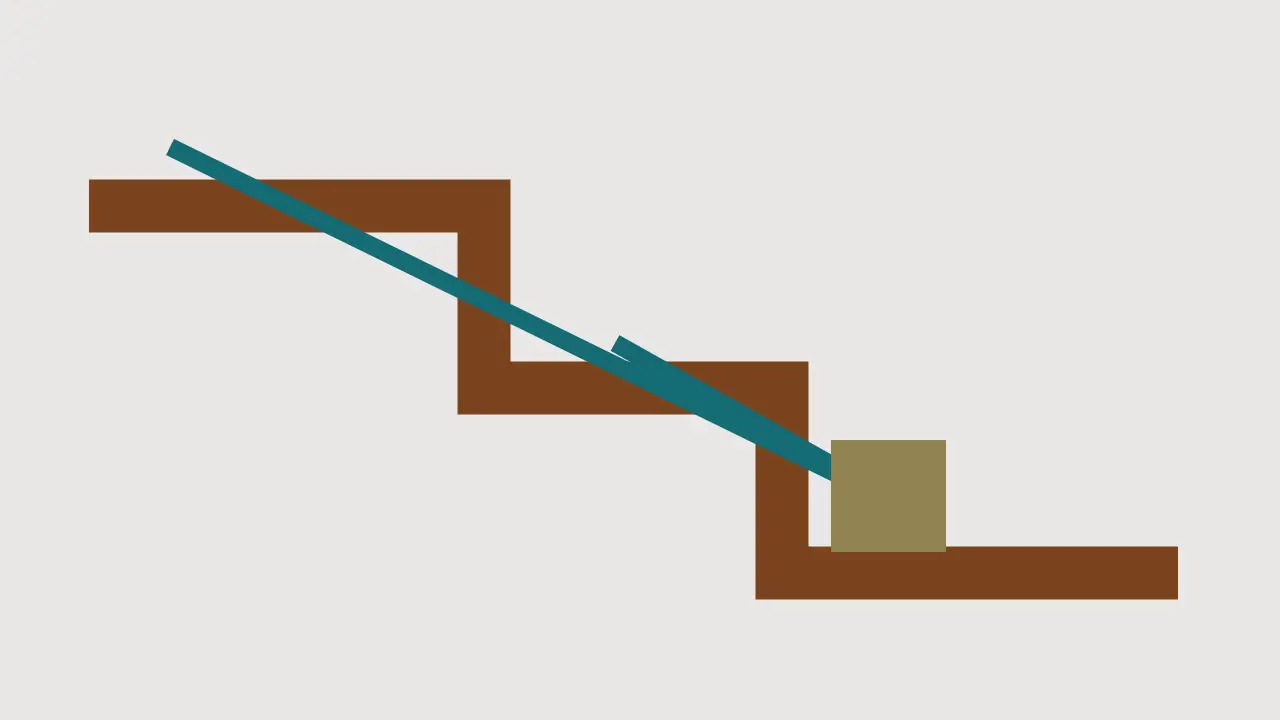
Under the Cut initially let the camera orbit the quarry rim from an elevated point. A player could see the whole staircase and turn the slab before walking anywhere. The problem was clear but the walk had almost no purpose. We added a recessed platform with its own view and left one useful detail out of sight from above. The case now gives the explorer a practical reason to move before using the control.
Find a clear first view that still has a limit
The quarry rim starts beside a slanted shelf. An upper view needs to show the first two steps and the slab that crosses the third. The camera stays high enough to expose the overall slope. A ridge at the lip then interrupts the line to the lowest step. On the old scene the camera tilted so far back that the viewer could see behind that ridge by moving a little sideways. We preserved the high overview and changed its available positions.
The recessed platform can be reached without moving the slab. The path to it is short and introduces no additional lock. We wanted a player to test a different viewpoint before worrying about the alignment mechanism. A small patch of teal runoff becomes visible just before the walk ends, giving a clear reason to look along the underside without adding a directional arrow.
Choose a height where the recess stays visible
We tried the lower camera near the level of the water. The recess looked dramatic but hid the edge of the near stair. It was possible to see the distinctive corner and impossible to see what needed to line up with it. Raising the camera slightly kept both edges inside the profile. The scene still looked up toward the overhang. The move from the upper view now reveals new information while retaining a point the explorer already saw on the approach.
A wide field of view produced a similar problem on the small screen. The upper plane filled most of the frame and the lower cut shrank toward the edge. We removed some of the empty floor from that view and kept the two relevant angles close together. The center of the view can stay quiet, with the steps still readable and the recess less likely to be mistaken for a shadow.
Review the route from both heights
After the explorer rotates the slab, they can still return to the upper view. It confirms that the start of the stair has stayed open. A second look from below shows whether the visible gap has become a reachable step. One reading can come from a convenient place to stand. The other needs a second route. On the current layout the return uses the same ledge, so the explorer can compare the two views without wondering whether the route itself moved.
The camera never changes the setting of the slab. An early interaction tried to snap the terrain to a good angle when a viewpoint was selected. That made rough motion look smoother but removed the player’s decision. The new interface preserves the most recent angle even when the view changes. If the edge is still blocked, the explorer can walk back and decide how much motion to try.
Check how much of the mesh makes this possible
Under the Cut records where the lower viewpoint sits in the first prototype. The corner shape shown in the mesh budget note is one of the details that stays visible from that position. We plan to check the route with a reader who only knows about the initial blocked stair. The change is working when they find the platform, describe something specific they can now see and use it to propose a turn that can be checked from above.