Under the Cut
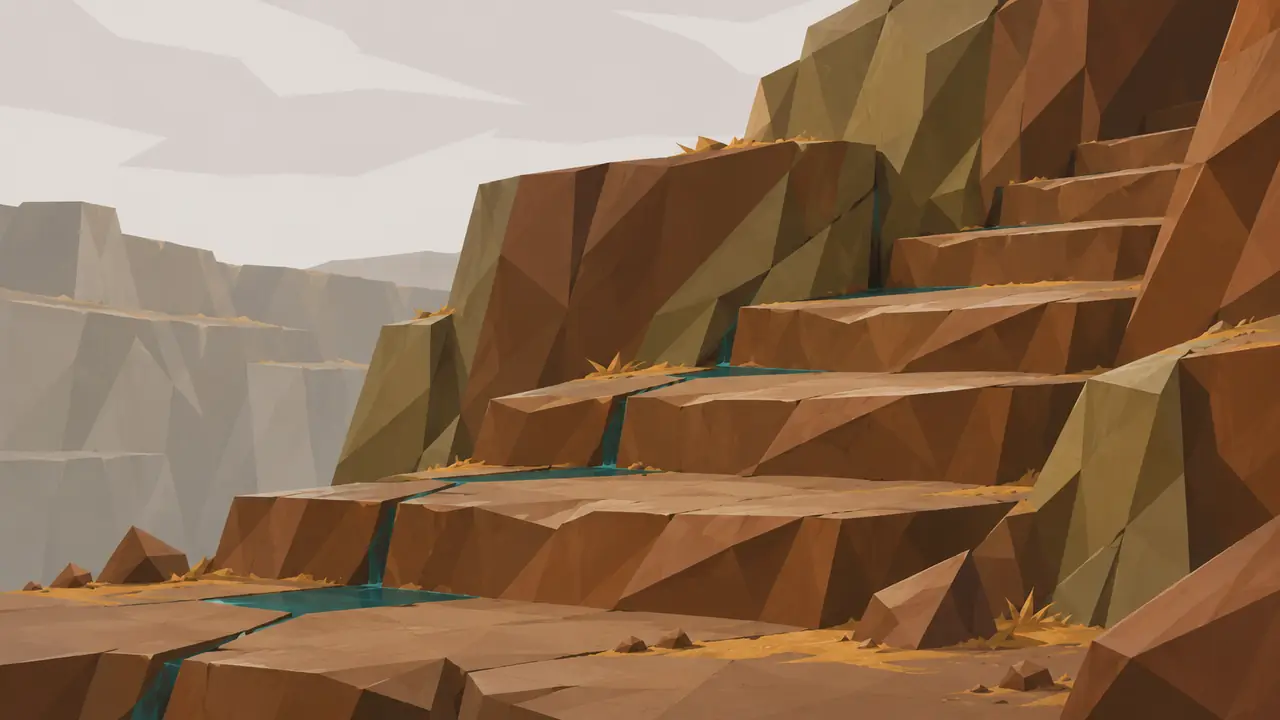
Under the Cut starts at the flat rim of an exhausted quarry. An angular staircase has been built into the excavation. The last step disappears behind a cut slab. Early travelers may be able to see the other side of the slab, but they cannot cross until they bring the lower step within reach. The available motion is short enough that understanding what to inspect matters more than turning every stone through a full circle.
Descend to the inspection platform
A narrow ledge on the left of the rim leads to a recessed platform. From there the explorer can see the underside of the slab. A small cut at its corner separates two possible faces the player might have confused from above. Turn the slab until that cut passes beyond the top of the lower stair. The edge of the higher platform remains available as a reference while this happens.
The main loop is to follow the cut, identify one visual feature, adjust the slab, then return far enough to see whether the next step is aligned. This is a route inspection rather than a single camera puzzle. Some positions offer a useful view even when they are poor places to make the final turn. Walking away from the hinge for a moment can tell you which section is still blocked.
Use the material to distinguish two edges
The walls are pale where the quarry has been exposed to warmer light. Lower faces keep a reddish edge and a few thin traces of teal water in cracks. On the slab the seam gets only a short highlight from below. A beveled edge would read as a path before the geometry could support one, so the prototype uses a crisp planar break. You can look for it while the upper level stays quiet.
The scene includes a subtle scratch as the slab changes its orientation. We use the sound to indicate motion and leave the exact slope to the existing silhouette. From the platform the explorer can compare how far the corner travelled and see whether the slot is broad enough to approach. Sparse light around the steps keeps the original rim distinguishable on the way back.
Take the next step before you judge the whole descent
After a small successful adjustment the lower route appears as a continuation of the stair. Returning up one tread lets you check whether the upper step is still clear. The prototype leaves both approaches open after the route is aligned. You can inspect the recess again and see which surface moved before the next scene starts. A successful position has a reason you can show from both heights.
Under the Cut is a concept in prototype development. The present exercise deals with the part of the descent just beneath the platform. The camera study follows the move to the lower view, while the mesh budget note describes where we kept the corner cut. The ridge reference uses an edge to solve a separate alignment across a saddle. Comparing the two shows where a movement of the camera can do more work than adding a detail to a moving surface.