The Hinged Ridge
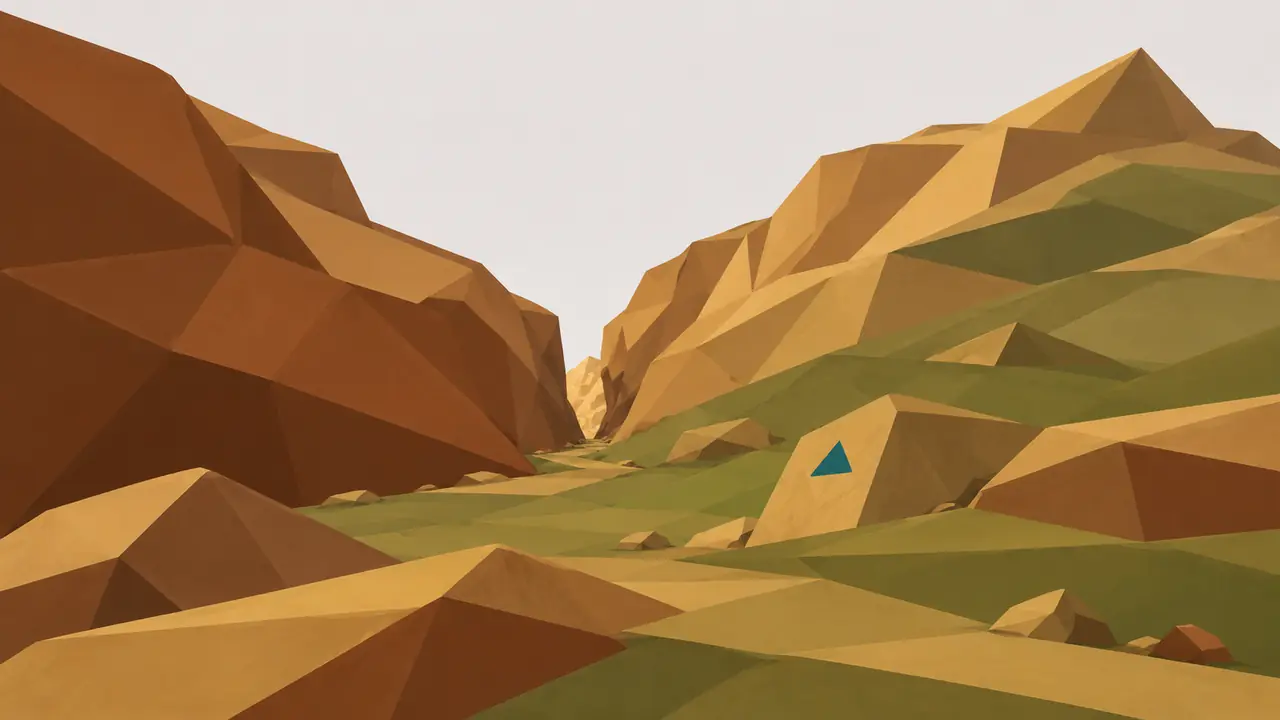
The explorer in The Hinged Ridge reaches a bare track that stops at a narrow opening between two hills. At eye level the shoulders overlap and the gap seems closed. Each shoulder can turn about a visible crease. The aim is to make a continuous route across the saddle with enough space to take the next turn. The opening does not appear until the edge and the ground agree.
Choose an edge you can compare after turning
The first position gives a clear view of one angular peak and its long descending face. Take that edge as a reference before turning. On the right there is a shorter face with a triangular tip. It can cross the line of the peak at several angles. The one useful crossing leaves the shelves at the bottom of both faces close enough for the explorer to step between them.
The central loop is to choose a position, set one portion of terrain, and walk to the edge to check the resulting route. If the overlap still hides the opening, you can return to the previous setting and inspect the other face. The explorer can see which part is moving. The stable part preserves a path back to a known view, so experimenting at the hinge never requires remembering a distant silhouette.
Let mineral color reveal a turn without declaring an answer
The environment has brown and warm gray planes with a quieter olive tint on upward surfaces. A narrow teal trail mark belongs to stable rock, so it remains in sight as a moving piece changes angle. In the blockout we left a quiet stretch of sky above the highest peak. It lets a single hard edge stay readable without giving the route a guiding outline that would solve the puzzle before the first turn.
Sound is sparse. A short gravel slide indicates that a weight has settled. It provides confirmation that a move has stopped, while the new path still has to be read by its visible shape. Along the saddle a dry footstep changes slightly as the ground gives way to a flatter slab. This can help connect the approach to the next surface after the pass opens.
Check both sides of the saddle
A gap seen through the sky can still be too high for the next step. The prototype lets you walk toward the newly suggested opening to find that difference. An edge can be matched without finishing the puzzle, giving the reader useful information on the route. At the far side a lower ledge offers another view of the original approach and a place to compare your working solution.
The Hinged Ridge is a prototype in development. The current exercise tests whether you can name the stable edge, turn one hill and explain why a particular gap is reachable. Read the rotation note for how the permitted motion was chosen and the outline study to see which silhouette we keep in view. The lower position in the quarry case tests a related problem with a shorter route and a different camera.