Keep the Outline
We once drew a narrow bevel along the top of the stable hill. It looked attractive beside a flat sky, but it split the ridge into several equally sharp outlines. As the moving flank passed the hill, reviewers followed a lit edge that disappeared halfway through the exercise. The stable reference needed to be something they could find from both ends of the crossing, under both lighting conditions.
Compare two plain sections before attaching materials
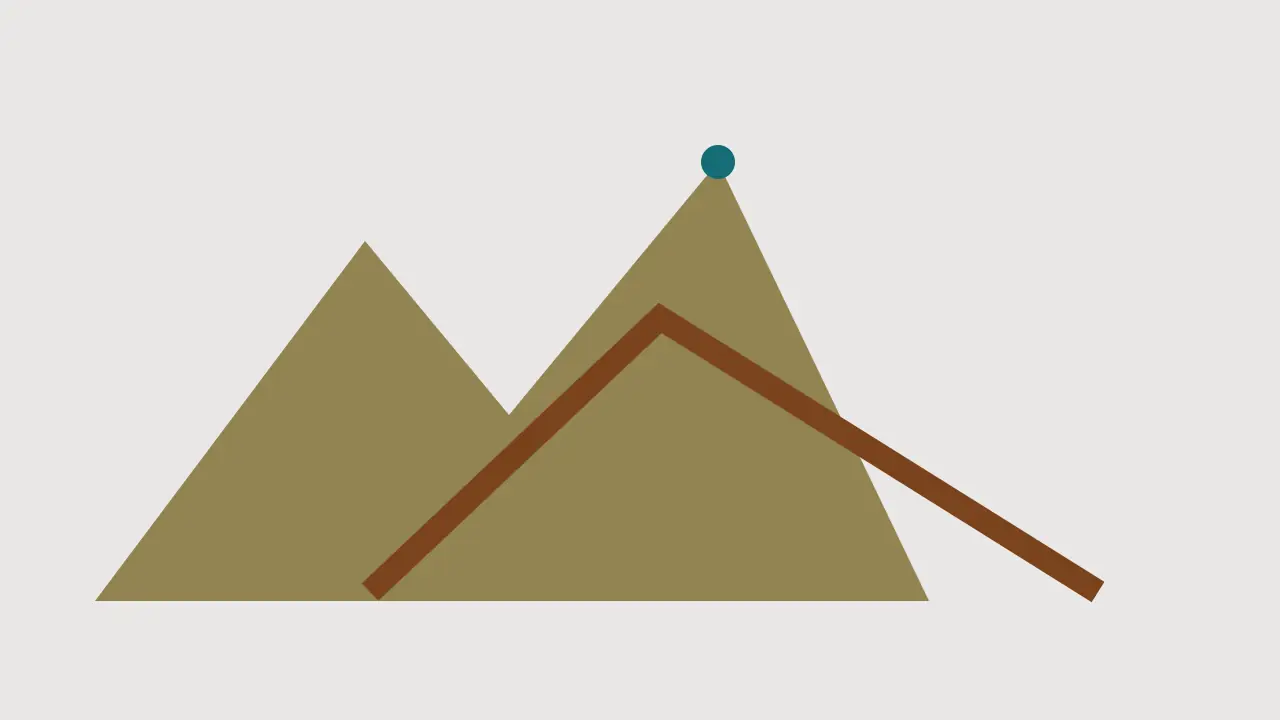
Put the stable hill behind the approaching track in a plain blockout. One side slopes up to a short triangular point. The other side drops in a single long face. From the initial position the two sides read separately. From the route around the saddle part of the longer face aligns with the moving flank. The triangular point is still visible before either rock changes relative height.
We use that point to connect the two views. It has a readable silhouette even when the broad face catches a different reflection. A player has a reason to keep it in mind when walking around the saddle. During the first version they usually reported a general slope and looked for another bright spot. Now they can describe a point and the edge falling away from it. The next view can confirm the same shape without needing a written label.
Set the outline before turning the other piece
The hinge prototype keeps the stable face in place while the higher flank rotates. The long side of the moving face crosses the same band of sky as it turns. If its silhouette touches the stable peak, the two positions become difficult to read as a pair. We adjusted the plane beneath the turning edge so the moment the shapes separate comes slightly earlier. The next section of the path still stays hidden until the ground lines up.
Removing two small outward bevels made it easier to recover the whole shape from below. Those bevels looked wider from a view along the seam. When they were removed we found that the low view did not need another highlight to sell the material. The texture could indicate a broad change in plane while the silhouette supplied the identity.
Let the material contrast fall on the nearer face
The main contrast in the study is between a dry upper plane and a darker side. The right shoulder is a little cooler from its lower position. We preserve the upper point even when those colors are reduced for the low light exercise. To check it, compare the two views using flat fills. A person should be able to trace the peak before seeing either material.
Where a strong patch of sky makes the guide hard to see, the contour can remain crisp without copying its shape into an overlay. The only added reference is a teal mark on stable ground. It can help somebody return to the same place after inspecting the edge. The reference is outside the part of the sky needed to compare the profiles.
Test which certainty belongs to the shape
In The Hinged Ridge a visible point helps a player name the right hill, and the turning face exercise keeps it in view while the other edge moves. The point is not proof that someone can step between the surfaces. The route still has to be checked lower down. We ask for both observations in review. First identify the peak from the approach. Then walk far enough to establish that the gap continues to a useful landing. The two answers let us see whether the underlying silhouette can guide an inspection on its own.