One Fewer Vertex
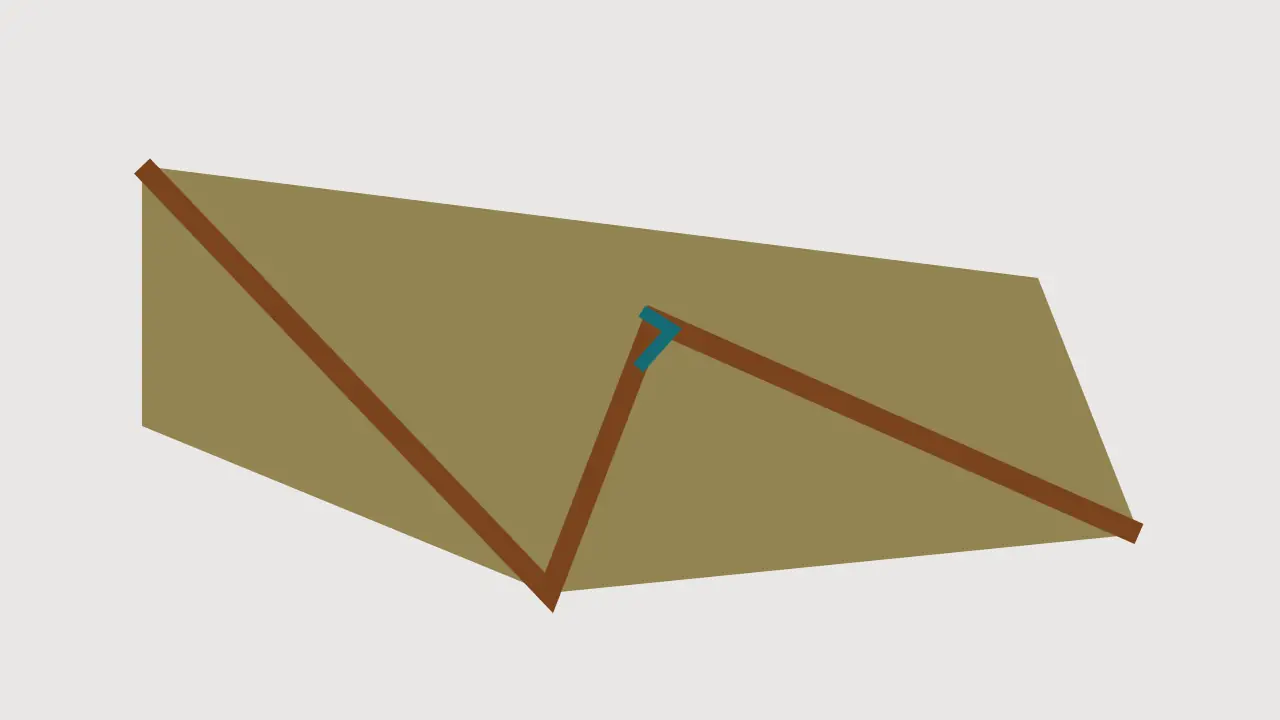
The initial quarry had a dozen small wedges along one cut slab. Each wedge helped a material catch the light, but only one contributed to the shape the explorer used for the alignment. We removed vertices away from that edge one at a time. The test gave the model a clearer profile and made the remaining corner easier to find from a second view.
Decide which lines define a possible route
The slab has an upper shoulder and a smaller part that reaches toward the bottom step. A narrow notch interrupts its side before the lower edge. The first test drew a line from that interruption to the start of the stair. If the notch moved in the wrong direction when the slab turned, the upper piece would still hide the next landing. We used the line as a construction check and left it out of the final play view.
Above the notch we had modeled several sharp chips. At the intended reading distance they merged into a pattern of small shadows. From the lower platform two chips looked like additional cuts with their own edges. A player could select one of them and then lose it while returning to the high view. Removing those chips left a clear line into the notch and made its orientation possible to compare.
Keep a small feature where it does real work
The lower cut needs a distinct side angle because the player sees it from an oblique position. Flattening it into the main face at that location lost the only readable cue to its depth. We restored that part and removed a vertex along the back of the slab where the silhouette did not change. Under quiet lighting the same angled corner remains visible near the recessed step.
We modeled the face with a darker material on the area that follows the cut. This helps a player see the facet after they have found the silhouette. The cut itself still has to be visible when the model is reduced to a plain profile. In the latest check, the two most useful faces remain distinct even with a soft reflection along the quarry wall.
Make each retained edge survive rotation
A stable mesh can still show confusing crossings from a second angle. The model should keep its relevant edge visible while the slab travels through the small permitted range. We inspect one position at the start, one near the angle at which the next step becomes visible and another at the end. The retained notch changes position and keeps its identity. On the opposite edge a longer flat face can move without suggesting a second usable recess.
The study leaves part of the wall quite plain. A simpler model does not require every surface to be equally empty. The interesting lines are concentrated where somebody can use them. A bright run of water can keep the approach recognizable without giving every cut a marker. On the model file the remaining vertices have a visible purpose when matched against the route.
Walk up and down before closing the study
Under the Cut puts the corner between its two possible views. The camera note explains why the lower platform keeps the rim and the cut in sight together. For this review we identify the cut before changing the slab, then make the adjustment and follow the path back to the upper step. Removing one more vertex is a useful test as long as we still have both observations. If it makes the two views stop agreeing, keeping that corner gives the player a better tool for inspecting the terrain.